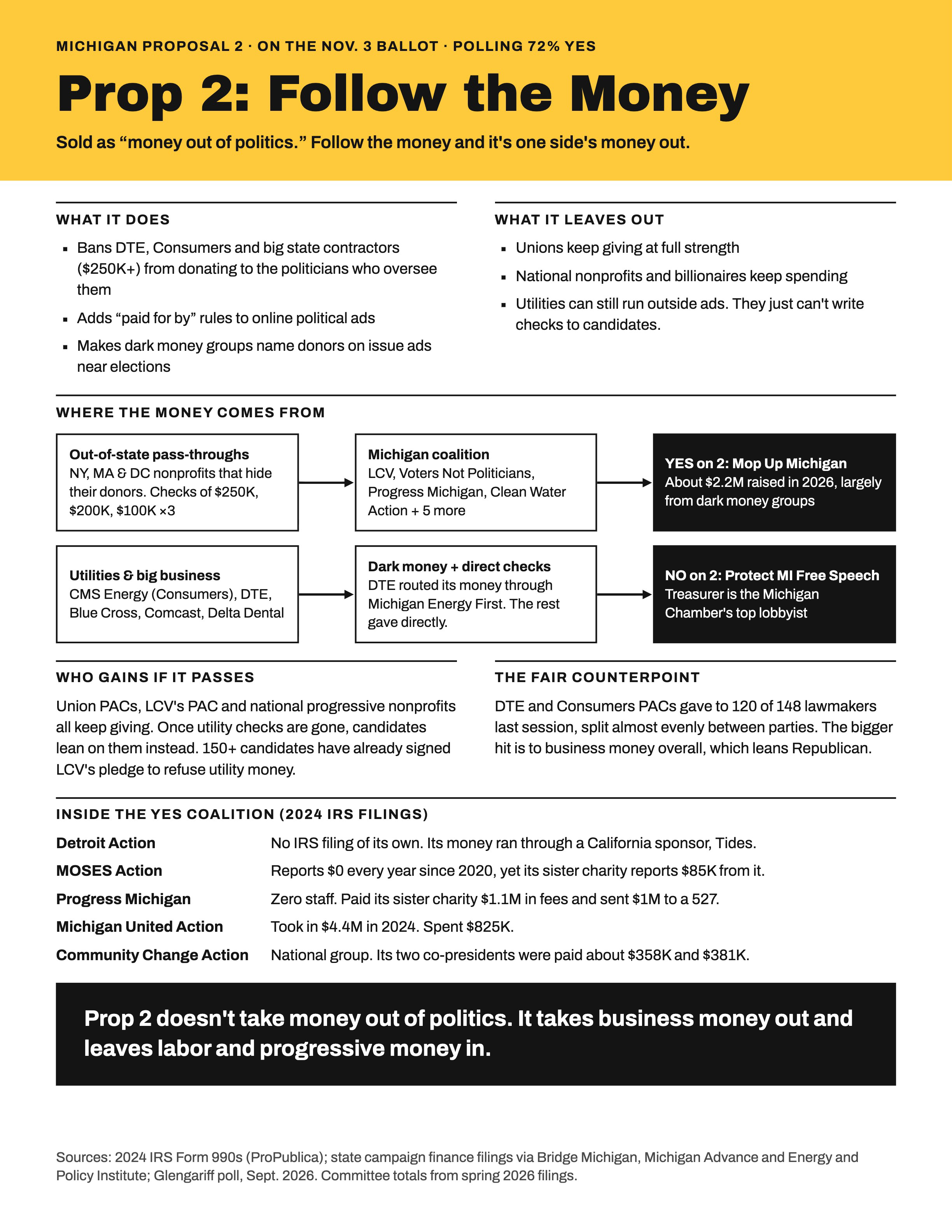
Sold as “money out of politics.” Follow the money and it is one side’s money out.
Proposal 2 bans campaign contributions from DTE, Consumers Energy, and contractors with more than $250,000 a year in government business. Union PACs, progressive nonprofits, and wealthy individuals with no contractor ties keep giving. The groups that wrote the measure are among those left standing, and the Yes campaign is funded largely by out-of-state nonprofits that do not name their donors.
beatdems.com briefing · October 2026 · Spring and summer filings
It covers regulated utilities and contractors with $250,000 or more in government business. Unions, nonprofits, and individuals with no contractor ties stay free to give.
2
“Money out of politics” is funded by dark money.
The Yes committee’s biggest 2026 checks came from New York, Massachusetts, and Washington, D.C. nonprofits that do not name their donors.
3
The coalition benefits.
Michigan LCV spent a year building a “No Utility Money” pledge and scorecard. Its own PAC, a major donor to statewide Democrats, is outside the ban.
4
The No side has its own plumbing story.
Most of the opposition committee’s early money went to the lawyer who runs both utilities’ dark-money groups.
5
The coalition’s tax filings look strange.
One group reports $0 for six straight years. One group with no staff pays its sister charity $1.1 million. One group has no IRS filing of its own.
Still open in the notes
Three items are marked as not ready to treat as settled: board overlaps beyond the one already confirmed on both Form 990s, why MOSES Action reports no activity, and why Michigan United Action held most of its 2024 revenue.
02 — The measure
What Proposal 2 actually does
Proposal 2 is an indirect initiated law, not a constitutional amendment. If it passes, the Legislature can change it only with a three-fourths vote of each house.
What it bans
Direct or indirect contributions from regulated electric and gas utilities, DTE and Consumers.
The same from contractors with more than $250,000 a year in government contracts, in Michigan or out of state.
The same from people and organizations with “substantial connections” to those companies, including immediate family.
The ban applies to contributions to officials or candidates for offices that affect the company.
What it discloses
“Paid for by” rules expressly cover internet political ads.
Disclosure extends to ads that clearly identify a candidate or a ballot question, even with no “vote for” or “vote against.” That is the issue-ad loophole dark money uses now.
What stays legal
Independent spending stays legal. Utilities can move money into outside ads. Donor disclosure would apply to those ads.
501(c)(4) spending stays legal outright. Issue ads near elections would have to name donors.
Union PACs, advocacy-group PACs, and individuals with no contractor ties stay legal.
Sources: Michigan Advance voter guide; Bridge Michigan; Citizens Research Council analysis. The three-fourths rule is from a Manifold summary of the official rule.
How it got on the ballot
561,282 signatures submitted. The requirement was 356,958.
The Board of State Canvassers certified it 3–1. A random sample found 645 valid signatures out of 1,000. The approval line was 636, so it passed by nine sample signatures.
Protect MI Free Speech sued in the Michigan Supreme Court. It argued the board used a “best guess” standard and that the right line was 661.
The court denied relief in a three-sentence order. No vote split was reported. The Legislature did not adopt the proposal during its 40-day window, so it went to voters.
Sources: WTOP/AP, MIRS, Michigan Public.
A court fight is likely if it passes
The Citizens Research Council noted that a federal appeals court upheld a ban on federal contractor contributions. Prop 2’s ban is broader, and that gap is where a challenge would aim. The case the notes point to is Wagner v. FEC (D.C. Cir. 2015, en banc). That citation is the notes’ own, and the notes say to confirm it with a campaign finance lawyer before leaning on it. The Michigan Chamber has called the language overly broad and a First Amendment problem.
Sources: Michigan Advance; Hoodline.
03 — The line
Who is covered, and who keeps giving
The ban targets business money with a regulatory or contract stake. Labor money, nonprofit money, and unconnected individual money stay in.
Scope of Proposal 2. “Still allowed” means the notes do not find that source inside the ban.
Source of money
Under Prop 2
Basis
DTE, Consumers, and their PACs
Banned
Michigan Advance guide
Companies with $250,000 or more in government contracts, plus connected people and family
Banned
Bridge
Union PACs
Still allowed
Bridge
Advocacy-group PACs, including Michigan LCV’s
Still allowed
Outside the ban’s categories
501(c)(4) nonprofits
Can still spend
Issue ads near elections must name donors. Bridge.
Out-of-state groups
Still allowed
Unless they hold a $250,000-plus contract. Bridge.
Wealthy individuals with no contractor ties
Still allowed
Outside the ban’s categories
Utilities’ independent ads
Not banned
Donor disclosure applies. Michigan Advance / CRC.
The partisan question, stated fairly
Utility PACs gave to both parties
DTE and Consumers PACs gave to 120 of 148 legislators’ campaigns or leadership PACs last session, nearly $560,000 over two years. The split was almost even. The utility piece alone is not a partisan hit.
The contractor piece is wider
Consumers says the ban covers 900-plus state contractors. That is business money, which in Michigan flows heavily through Chamber-aligned channels. A data reporter could test the lean by pulling contributions from the state’s contractor list. The Chamber’s line is that the measure gives labor unions a free pass.
Open question
Whether the parties’ administrative accounts are affected. Democrats spent nearly $13 million from theirs on 2024 state House ads. Read the petition text before saying either way. The bipartisan utility split cuts against a “this disarms Republicans” frame. Make any partisan point about business money broadly, and say how it was measured.
Source: Bridge Michigan.
04 — Both campaigns
Two committees, two kinds of undisclosed money
Both campaigns lean on nonprofit money that does not disclose its donors. The Yes side’s money is national and progressive. The No side’s is utility-linked and hospital-linked. On each side, the money went straight to the committee.
People on the two committees.
Committee
Role
Person
Mop Up Michigan (Yes)
Co-chair
Christy McGillivray, executive director of Voters Not Politicians
Mop Up Michigan (Yes)
Co-chair
Sean McBrearty, environmental activist
Protect MI Free Speech (No)
Treasurer
Wendy Block, the Michigan Chamber’s head lobbyist
Protect MI Free Speech (No)
Spokesperson
John Sellek
Protect MI Free Speech (No)
Lawyer
Eric Doster, paid $47,000-plus. His wife, Mary, is the recordkeeper.
Protect MI Free Speech (No)
Lawyer in the signature challenge
Gary Gordon
The Yes side calls itself a bare-bones campaign and dares critics to compare its roughly $2.2 million with whatever the opponents raise. That $2.2 million is the 2026 total as of late April. The October reports, due around October 23, are the first full look at fall money, and they will settle the comparison.
Where the one-pager maps the money
Out-of-state pass-throughs
New York, Massachusetts, and D.C. nonprofits that hide their donors. Checks of $250,000, $200,000, and $100,000 three times.
→
Michigan coalition
LCV, Voters Not Politicians, Progress Michigan, Clean Water Action, and five more.
→
Yes on 2 · Mop Up Michigan
About $2.2 million raised in 2026, largely from groups that do not name donors.
Utilities and big business
CMS Energy (Consumers), DTE, Blue Cross, Comcast, Delta Dental.
→
Dark money and direct checks
DTE routed its money through Michigan Energy First. The rest gave directly.
→
No on 2 · Protect MI Free Speech
Treasurer is the Michigan Chamber’s top lobbyist.
Yes donors: Bridge, April 27, 2026, and Hoodline on Tides. No donors: Bridge, April 27; Bridge on Consumers and Blue Cross; Energy and Policy Institute, July 28. The check sizes and the company list are the one-pager’s map of those reports. Look the committees up on FollowMiMoney.com.
Who gains if it passes
Union PACs, LCV’s PAC, and national progressive nonprofits all keep giving. Once utility checks are gone, candidates lean on that money instead. The one-pager says 150-plus candidates have already signed LCV’s pledge to refuse utility money.
The fair counterpoint
DTE and Consumers PACs gave to 120 of 148 lawmakers last session, split almost evenly between the parties. The bigger hit is to business money overall, which leans Republican.
05 — DTE and Consumers
The PAC checks are the small money
The utilities’ PAC giving is modest. Their real political money moves through nonprofits that do not disclose donors.
DTE and Consumers PACs gave nearly $560,000 to 120 of 148 legislators over the last two-year session.
The dark-money groups
These figures are from the Energy and Policy Institute, a utility-watchdog group. Check them against the filings.
Michigan Energy First, DTE-linked. DTE reported putting $8 million into it between September 2024 and August 2025. It had a $4.3 million balance at the end of 2024. It has received $51 million-plus since 2014, per ProPublica data cited by EPI.
Citizens for Energizing Michigan’s Economy, Consumers-linked. With other groups, it spent more than $1 million in 2018 to unseat a utility critic in the state House. In 2026, CEME and a related group spent $270,000-plus on ads in Rep. Steve Carra’s Republican primary. Carra won.
Eric Doster, a Lansing election lawyer, helps run both groups. He is also the lawyer paid $47,000-plus by the No committee.
In 2023, DTE shareholders voted down a proposal to disclose the company’s dark-money spending. The proponents cited Michigan Energy First by name. Both utilities say no customer money goes to political contributions, and DTE says it complies with all laws.
Under Prop 2’s disclosure rules, Michigan Energy First and CEME issue ads near elections would have to name donors. That may hit the utilities harder than the contribution ban does.
DTE Foundation money and the coalition
The only direct DTE money to a coalition member on record is $115,000 from the DTE Energy Foundation to the Michigan LCV Education Fund, from 2013 to 2018. It stopped after 2018. LCV has since become one of DTE’s loudest critics. No 2019–2024 grants to any coalition member turned up.
DTE Energy Foundation grants to the Michigan LCV Education Fund. EIN 38-2708636. Read from IRS e-file data. Each year’s parsed grants add up to the return’s reported total.
Tax year
Amount
Stated purpose
2018
$20,000
Environmental leadership
2017
$20,000
Environmental leadership
2016
$10,000
Environment
2015
$30,000
Environment
2014
$30,000
Environment
2013
$5,000
Civic and community
Total
$115,000
What was checked and came up empty:
DTE Foundation, 2013–2024: no grants to Clean Water, MOSES, Michigan United, Detroit Action, Voters Not Politicians, Progress Michigan, Climate Cabinet, or Community Change.
Consumers Energy Foundation, 2020–2024, and the CMS Energy Foundation: no grants to any coalition member, LCV included. Consumers’ 2018–2019 returns exist only as scans and were not checked.
Tides: DTE’s foundation gives to the Tides Foundation every year, for example $80,000 in 2024 and $92,500 in 2023. No grant names Detroit Action, which was a Tides Advocacy project. A 2020 return lists $228,500 in future commitments to Tides at a Detroit address, 8220 Second Ave. Find out what organization is at that address before drawing any line to Detroit Action.
Rate-case settlements: Michigan LCV and the other coalition members were not parties to DTE’s 2023 energy-plan settlement (U-21193) or Consumers’ 2023 settlements at the Michigan Public Service Commission. Signers included the Sierra Club, NRDC, Soulardarity, and the Attorney General. That settlement is what forced DTE to start publishing annual political-giving reports.
No sponsorship of any LCV event by DTE or Consumers turned up.
Where DTE’s political money did go in 2025: $40,000 each to the Michigan Senate Democratic Fund and the House Republican Campaign Committee. Speaker Matt Hall was the top individual recipient, at $7,000, in a Michigan LCV analysis dated March 4, 2026. In the first four months of 2026, DTE gave $82,250 and Consumers gave $74,510 to lawmakers.
The story those records support is narrower than “DTE funds the coalition.” LCV took DTE foundation money for six years, and then it turned on the company. The open questions are when and why the grants ended, and whether DTE cut them off.
A related pattern, outside this coalition: DTE’s foundation has funded Detroit community leaders who then backed DTE at the MPSC, including $50,000 to the Detroit Association of Black Organizations in 2017. None of those recipients are Prop 2 coalition members.
Sources: DTE Energy Foundation Form 990-PF; ProPublica; Michigan Advance; Michigan LCV analysis, March 4, 2026; Metro Times, 2019. Search DTE on FollowMiMoney.
Sen. Darrin Camilleri and DTE’s chief lawyer
State records list $32,450 in personal contributions since January 2023 from JoAnn Chávez, employer DTE. DTE identifies her as senior vice president and chief legal officer. Most of it went to Camilleri-linked committees. If Prop 2 passes, giving like this from a utility’s top executive appears to be exactly what the ban covers.
Personal contributions from JoAnn Chávez in the notes’ pull of state records. A reporter should pull the filings directly.
Date
Recipient as recorded
Amount
Oct. 6, 2025
Camilleri for Michigan
$15,000
Oct. 18, 2024
Camilleri for Michigan
$15,000
Nov. 20, 2023
Senate committee
$2,450
Total
$32,450
Camilleri is the Democratic state senator from the 4th District, in office since 2023, and a state representative from 2017 to 2022. His candidate committee is “Darrin Camilleri for State Senate.” His likely defense is that he backs a ban precisely because the current system rewards this kind of giving. Get that answer on the record before treating the donations as the end of the story.
Questions the notes leave for him, for DTE, and for the Yes campaign are in the questions section. The pattern check still to do: other DTE senior officers’ personal giving since 2023, and which legislators they cluster on.
06 — The Yes coalition
Nine groups, mostly in pairs
The nine coalition groups mostly run in pairs. A 501(c)(4) can do politics. A 501(c)(3) is the charity. They share staff. Figures are from 2024 Form 990s on ProPublica. Overhead here means management plus fundraising as a share of total expenses. These filings are from 2024, before the 2026 campaign. They show how the groups operate. They are not a Prop 2 spending report.
2024 revenue is listed as c4, then c3. Overhead is the same order. The table scrolls sideways on a phone.
Group
Who runs it
2024 revenue, c4 · c3
Top pay
Overhead, c4 · c3
Community Change Action (national)
Co-presidents Lorella Praeli and Dorian Warren
$6.8M · $43.6M
Praeli about $381,000, Warren about $358,000, both entities
5% · 21%
Michigan United Action
Kenneth Whittaker, executive director
$4.4M · $8.2M
Executive director about $80,000
28% · 4%
Michigan LCV
Lisa Wozniak, CEO
$6.0M · $2.1M
Wozniak about $211,000, both entities
9% · 15%
Clean Water Action (national)
Lynn Thorp, president; Emily Woodcock, Michigan director
$5.9M · $6.1M
Former CEO about $210,000
42% · 19%
Progress Michigan
Justin Mendoza, executive director (2026)
$4.4M · $3.9M
Former executive director about $123,000
6% · 5%
Climate Cabinet (national)
Caroline Spears, founder
$2.2M · $2.6M
Three staff from $135,000 to $146,000
16% · 8%
Voters Not Politicians (Count MI Vote)
Christy McGillivray, executive director and Prop 2 co-chair
$1.2M · $4.2M
Former executive director about $128,000, both entities
15% · 3%
MOSES Action
Ponsella Hardaway, executive director
$0 · $1.2M
Executive director about $77,000
n/a · 23%
Detroit Action
Scott Holiday, executive director
No filing yet
n/a
n/a
What stands out, group by group
Progress Michigan. The c4 lists zero employees. It paid its own c3 $1.11 million in management fees, and its political expenditures were $1.35 million. Of that, $1.0 million went to the Millions of Michiganians 527 and $295,000 to Progress Michigan PAC.
MOSES Action. It reports $0 in revenue and $0 in expenses for 2020 through 2024. The MOSES c3’s Schedule O reports receiving $85,247 under a cost-sharing agreement with MOSES Action. The money runs from MOSES Action to the charity. The charity also books $389,000 of salaries on the “disqualified persons” line, which looks like a form error. Why an entity that reports no activity is in a cost-sharing deal is one of the open items.
Michigan United Action. The legal name is Michigan Peoples Campaign. Revenue jumped from $1.2 million in 2023 to $4.4 million in 2024, while expenses were $825,000. The c3’s Part IX shows $156,000 of officer pay, and Schedule O says the executive director earns $79,581. The two figures do not match. The unspent revenue may be multi-year grants. Ask before implying a motive. Whether it is being held for 2026 is an open question.
Detroit Action. It ran for years as a fiscally sponsored project of Tides Advocacy, now Beyond Impact, so its money sits inside a $65.8 million consolidated return. Its new c4 and c3 got IRS exemption in late 2024 and have no 990 on ProPublica yet. A missing filing may only be timing. Progress Michigan’s 2024 grant of $100,000 to “Detroit Action” was paid to Tides Advocacy’s EIN.
Voters Not Politicians. The c3 reports zero employees and books $715,912 as “shared employee cost.”
Clean Water Action. Its 42% overhead comes from a paid door and phone canvass staffed by 527 people, booked largely as fundraising. It lists a related for-profit, Citizens Campaign Inc.
Climate Cabinet. The c4 reported $360,862 in political spending and filed Form 1120-POL. It is hiring a Michigan lobbyist.
Michigan LCV. The c4 paid out $1.45 million in grants. The recipients are on Schedule I and are worth pulling.
Community Change. The co-presidents’ pay is national. It is context for the size of the organization. It is not Prop 2 money.
Board overlaps worth reporting
Progress Michigan’s c4 board, from its 990 plus affiliations listed by InfluenceWatch:
Bob Allison, Michigan LCV deputy director. Confirmed on both 990s. Michigan LCV lists Robert Allison as deputy director at $108,670.
Doug Pratt, Michigan Education Association public affairs director. InfluenceWatch. Confirm with him or the employer.
Jennifer Root, SEIU Michigan executive director. InfluenceWatch. Confirm.
Patrick Schuh, chair, America Votes Michigan state director. InfluenceWatch. Confirm.
Steven Pontoni, Michigan Association for Justice executive director. InfluenceWatch. Confirm.
InfluenceWatch is run by the Capital Research Center, a conservative group, so the notes say to confirm each affiliation except Allison, who is already on both tax forms. Unions on the board of a coalition member are the hook: unions are the money Prop 2 leaves alone. Treat every name but Allison as reported, not confirmed.
Prop 2 doesn’t take money out of politics. It takes business money out and leaves labor and progressive money in.
07 — Limits
What not to overstate
From the notes, before publication
Overhead percentages are soft. Paired groups share staff and book the shared costs on whichever side they choose. A low number does not prove a low administrative cost.
The 990s cover 2024, before the 2026 campaign. They show how the groups operate, not what they spent on Prop 2.
Community Change pay is national. Use the co-presidents’ salaries for scale, not as a Michigan claim.
The MOSES $85,000 runs from MOSES Action to the c3. The charity reports receiving it. An earlier draft of the notes had the direction backwards.
Michigan United Action’s unspent revenue may be multi-year grants. Ask before implying anything.
Detroit Action’s missing filings may only be timing. The new entities got exemption in late 2024.
The bipartisan split cuts against a “this disarms Republicans” frame. Utility PAC money went to both parties.
Committee totals here are from spring and summer filings. Update them with the October reports.
The Energy and Policy Institute and InfluenceWatch are advocacy sources from opposite sides. Verify their facts against primary filings.
The Wagner citation needs a campaign finance lawyer before anyone publishes it as the case that controls.
08 — Still to ask
Questions the notes leave open
Mop Up Michigan
Christy McGillivray and Sean McBrearty
Why does the ban cover utility and contractor PACs and leave union PACs alone? Was covering unions considered and dropped?
Who are the donors behind Working Families Organization, All Hands on Deck, Movement Voter Project, Green Advocacy Project, and Pro-Democracy Campaign? Will the campaign ask them to disclose?
Under Prop 2’s own disclosure standard, would the funders’ issue ads have to name donors?
Michigan LCV’s PAC is a top donor to statewide Democrats. Does the coalition see a conflict in banning a rival donor class while its own members keep giving?
McGillivray runs Voters Not Politicians, a coalition member. Is she paid by the ballot committee, by VNP, or by both?
The signature sample cleared by nine. Did the campaign review the opposition’s claims about invalid signatures?
Coalition nonprofits
MOSES Action: how does an entity that reports $0 every year pay $85,000 under a cost-sharing deal?
Michigan United Action: what was the $4.4 million in 2024 revenue, and why was most of it unspent? Is it being held for 2026?
Progress Michigan: why does the c4 have no staff? Who decides the $1.1 million fee it pays its c3? Who funded the Millions of Michiganians 527?
Detroit Action: when will the new entities file 990s? How much of the Tides-sponsored money was for Detroit Action?
Bob Allison: does serving as LCV’s deputy director and on Progress Michigan’s board create any conflict in coalition decisions?
Protect MI Free Speech
John Sellek and Wendy Block
How much has Eric Doster been paid, and does he also advise Michigan Energy First and CEME on Prop 2 ads?
Why did DTE give through Michigan Energy First instead of directly?
Will the utilities move money into independent spending if Prop 2 passes?
Does the committee plan a First Amendment lawsuit if it passes, and who would bring it?
DTE, Consumers, and Camilleri
How much did each utility put into Michigan Energy First or CEME in 2025 and 2026?
If Prop 2 passes, will they keep funding those groups under the new disclosure rules?
For Camilleri: do you support Prop 2? Will you return or stop accepting money from DTE executives? What is Camilleri for Michigan, and what does it fund?
For DTE: does Chávez give on her own, or as part of a coordinated executive giving program? Do other DTE officers give to the same committees?
For the Yes campaign: would Prop 2 ban Chávez’s contributions? Does it treat a senior officer as “substantially connected”?
Documents still to pull
The pre-general campaign finance reports, due around October 23, are the first full look at both committees’ fall money. Confirm the exact dates on the Secretary of State’s filing calendar.
Tap the page to open the full image. Right-click it, or use the download button, to save it.
10 — Sources
Where the figures come from
News and analysis
Bridge Michigan: More dark money flows to Michigan ballot groups (April 27, 2026)
Bridge Michigan: Fact check, would Prop 2 live up to its name
Bridge Michigan: Proposal aims to ban political spending by DTE and Consumers
Bridge Michigan: Consumers and Blue Cross fight the proposal
Bridge Michigan: Initiative aims to reveal dark-money donors
Michigan Advance: Voter guide, Proposal 2
Michigan Advance: Citizens Research Council analysis
Michigan Advance: Coalition members (July 2025)
Michigan Public: Supreme Court asked to block the question (August 6, 2026)
Michigan Public: Ballot is official (September 4, 2026)
MIRS: Supreme Court allows the proposal to go to voters
WTOP/AP: Proposal cleared for the ballot
Hoodline: Tides and Chamber positions
Manifold market: Glengariff poll details and the official ballot summary
Advocacy sources, verify against the filings
Energy and Policy Institute: DTE and Consumers oppose the initiative (July 28, 2026)
Energy and Policy Institute: Consumers bankrolling the opposition
InfluenceWatch: Progress Michigan
Michigan Chamber: court review update
Michigan LCV: No Utility Money Challenge
IRS filings on ProPublica Nonprofit Explorer
Michigan LCV, c4 and c3
Voters Not Politicians (Count MI Vote), c4 and c3
Clean Water Action, c4, and the Clean Water Fund
Climate Cabinet Action and Education
Progress Michigan, c4 and c3
Detroit Action, c4 and c3
Michigan United: Michigan Peoples Campaign and Michigan Organizing Project
MOSES Action and the MOSES c3
Community Change Action and the c3
DTE Energy Foundation Form 990-PF, EIN 38-2708636
Committee totals on this page are from spring and summer filings. The Yes side had about $2.2 million in 2026 as of late April, according to Bridge. Replace that number when the October reports land.